
What's in the Box
The packaging is understated compared to the flashier culinary kits. A plain brown box containing a 2kg hardwood substrate block, a humidity tent, and a four-page instruction booklet. The instructions are well-written and, crucially, they set expectations properly from the first paragraph: "Reishi is a slow-growing species. This is not a weekend project."
The substrate block was fully colonised with bright white mycelium, dense and firm. When we opened the bag, the smell was different from any other kit we've tested. less earthy, more woody, with a faintly bitter undertone. It smelled, appropriately enough, like tree bark. There was also a faint reddish-brown discolouration on one end of the block, which initially worried us. The instructions helpfully explain that this is normal. it's the reishi mycelium beginning to produce pigment, and it's actually a sign of a healthy, mature block.
No spray bottle included, which is fine. The instructions note that reishi needs less misting than oyster species. once or twice daily is sufficient. The humidity tent provided was the same design as the other kits in this range: clear plastic with adjustable vents at the top.
Setup & Growing Experience
Setup is the same as other kits: cut a slit, tent, mist. But from that point onward, the experience diverges completely. Where oyster kits deliver visible results within a week, reishi operates on a fundamentally different timescale.
We set the kit up in early January in our spare bedroom at 20-22°C. The instructions specify 20-25°C for antler growth, which is warmer than most UK houses manage in winter without heating. We kept a small radiator on a low setting in the room.
Week 1: Nothing visible. The block sat there looking exactly as it did on day one. We misted once daily and tried not to hover.
Week 2: A small white nub appeared at the slit, about the size of a pea. This was the very beginning of a reishi antler. Growth was measurable in millimetres per day, if that. We caught ourselves checking multiple times daily, which the instructions gently discourage. "Reishi rewards patience, not attention."
Week 3-4: The nub elongated into a finger-like protrusion, about 3cm long and 1cm thick. The surface was white and slightly fuzzy, with a firm, almost woody texture when lightly touched. A second smaller nub appeared alongside it. The whole thing looked like tiny white antlers growing from a log. which, essentially, is exactly what was happening.
Week 5-6: Both antlers continued to elongate. The taller one reached about 7cm, the shorter about 4cm. Colour began to change. the base of each antler developed a reddish-brown colouring that gradually crept upward. The white growing tips remained, looking like they'd been dipped in paint. It was genuinely beautiful. We found ourselves showing it to visitors like a proud parent with baby photos.
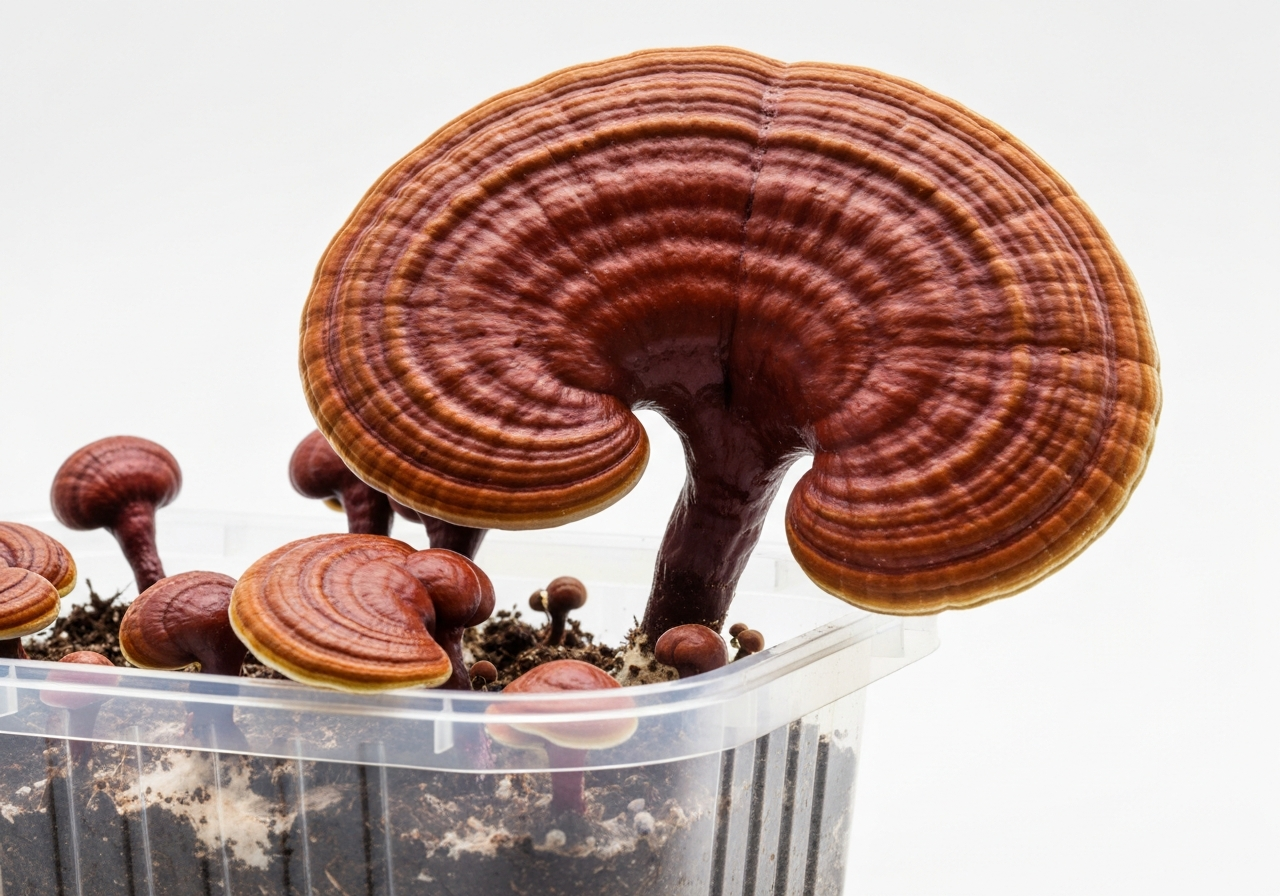
Week 7-8: Growth slowed. A third antler emerged but remained small. The two main antlers reached about 10cm and 7cm respectively. The red-brown colouring had intensified to a deep, lacquered mahogany that caught the light beautifully. The surface developed a slight sheen, almost as if it had been varnished. Our partner said it looked like a miniature piece of modern art. Hard to disagree.
The instructions note two possible growth forms: "antler" (upright fingers, produced in low-light, high-CO2 conditions) and "conk" (flat, shelf-like fans, produced in bright light with good air exchange). Our tent setup naturally produced the antler form, which most growers find more attractive. If you want conks, you'd need to remove the humidity tent and provide more light and airflow.
Week 10 was when we decided to harvest. The antlers had stopped growing visibly, and the instructions suggest harvesting when growth stalls and the surface is fully coloured. We cut them at the base with a sharp knife. They were surprisingly hard. like cutting through a dense woody branch.
Results
Reishi yields are measured differently from culinary kits, because you're harvesting dried-weight woody material, not fresh edible mushrooms:
- First harvest (week 10): Three antler formations. Total fresh weight: 85g. After drying for 5 days on a wire rack: 35g.
- Second harvest (week 18): Two smaller antlers from the same block. Fresh weight: 45g. Dried: 18g.
- Total dried yield: approximately 53g.
For context, dried reishi slices sell for approximately £3-5 per 10g from health food shops and online suppliers. So 53g of dried reishi represents roughly £16-26 in shop value. not quite covering the £27.99 kit cost, but close. Factor in the growing experience and the quality (you know exactly how it was produced), and the value proposition is reasonable.
Now, the important bit: you cannot eat reishi like a normal mushroom. We tried. Out of curiosity, we sliced a thin piece off the fresh antler and chewed it. The bitterness was immediate and intense. like chewing an aspirin tablet dissolved in strong coffee. Our face, apparently, was quite something. Reishi contains triterpenoid compounds that are profoundly bitter, and no amount of cooking will make them palatable as food.
What you can do is make tinctures and teas. We sliced the dried antlers into thin pieces and simmered them in water for two hours to make a reishi decoction. The resulting tea was dark amber, earthy, and yes, bitter. but mixed with honey and a slice of lemon, it was actually quite pleasant. Like a strong herbal tea with a woody backbone. We also started a dual-extraction tincture (alcohol soak followed by water decoction), which is the traditional method for extracting both the alcohol-soluble triterpenoids and the water-soluble polysaccharides.
Beyond the practical applications, the dried antlers are genuinely decorative. We placed the largest one on a small wooden stand on our bookshelf. The deep mahogany colour and organic shape make it a conversation piece. Several visitors have assumed it's a bought sculpture.
Who It's For
This kit is for a specific person: someone interested in medicinal mushrooms, willing to wait two months for results, and comfortable with the fact that they're not growing dinner. It's a project, not a quick win.
It's also excellent for anyone who appreciates the aesthetic side of mushroom growing. The antler formations are genuinely beautiful, and watching them develop over weeks. the colour changes, the slow elongation, the lacquered surface. is a meditative experience that's completely different from the instant-gratification buzz of an oyster kit.
Herbalists and wellness enthusiasts will find obvious value here. Growing your own reishi gives you complete control over the substrate and growing conditions, which matters if you care about the source of your supplements.
Not suitable for anyone wanting quick results. the Pink Oyster Family Kit is the opposite end of the patience spectrum. Not for families with young kids, who'll lose interest long before anything visible happens. And emphatically not for anyone looking for culinary mushrooms. try the Lion's Mane Complete Kit or the Premium Oyster Growing Kit instead.
Verdict
We'll be honest: when we started testing this kit, we weren't sure what to make of it. A mushroom you can't eat? That takes two months to grow? In a lineup dominated by oyster and shiitake kits that deliver results in a fortnight, it felt like an outlier.
But by week 6, when those mahogany antlers were catching the afternoon light on our spare bedroom shelf, we understood the appeal. This isn't about efficiency or yield-per-pound. it's about growing something genuinely beautiful and unique. The process itself is the product, and the dried reishi at the end is a meaningful bonus for anyone interested in medicinal mushrooms.
The 8-12 week timeline will deter impatient growers, and the bitter, inedible nature of the harvest means it's not for everyone. But for the right person. patient, curious, interested in the broader world of fungi beyond the dinner plate. this is a deeply satisfying kit. 8.0 out of 10.
Related Reviews
- Lion's Mane Complete Kit Review. another specialist species with outstanding results
- King Oyster Indoor Kit Review. for those who want patience rewarded with dinner